Rats in drains are more common in Merseyside housing than most homeowners realise. The brown rat (Rattus norvegicus) is a semi-aquatic animal that thrives in foul water sewers. It is not struggling down there — it is at home. The moment a householder spots scratching behind the kitchen toilet, bite marks on an outside bin, or droppings around an external gully, the question is not whether rats are present but how they are getting into the property drainage.
At Blocked Drains Liverpool we attend rat-related drainage jobs most weeks, often in partnership with pest control contractors. This guide sets out why poison alone rarely works, what the drainage engineer's job actually is, and the permanent solutions that keep rats out for good.
Why Rats Live in Drains
The UK public sewer network is a warm, humid, predator-free environment with a constant supply of food and water. The rat population in any urban area is predominantly sewer-based — estimates for central Merseyside put it in the hundreds of thousands. Most of those rats never surface. They live, breed and die in the network.
The problem for homeowners starts when a defect in the local drainage gives rats a route out of the sewer and into private property. That might be:
- A broken or cracked clay drain under a garden.
- An unsealed capped branch left from a removed toilet or kitchen.
- An open gully where the grate is missing or damaged.
- A disused soil stack with an uncapped open end.
- A displaced joint on a lateral drain.
Once a route is open, a colony will exploit it repeatedly. Killing individual rats with poison does not close the route. A new rat from the same sewer will follow the scent within days.
Signs You Have Rats in the Drainage
Scratching from Behind Walls, Floors or the Toilet
Particularly at night. Rats are nocturnal and active from dusk to dawn. Scratching from behind a ground floor WC, from under the kitchen floor, or from a cavity wall on an external corner is a strong indicator of drainage ingress.
Droppings Near External Drains
Rat droppings are 10 to 20mm long, spindle-shaped, and dark. Around external gullies, along the base of an external soil stack, or in a yard next to a manhole is the classic pattern.
Gnawed Bait Station Activity
If a pest controller has laid bait and it is being taken rapidly, the population feeding on it is being topped up from the sewer. Bait consumption that does not taper off over two to three weeks means the route is still open.
A "Dusty" or "Musty" Smell
Rats produce a characteristic stale, slightly oily smell, distinct from a sewage smell. Homeowners often describe it as the smell of an old shed.
Damage to Lawn or Garden
Shallow runs, freshly-dug tunnel entrances near a manhole cover, or a small hole that keeps reopening are signs of rats entering and leaving via a broken drain just below the surface.
Flies or Smell Around a Specific Gully
A gully that smells bad even after cleaning may indicate a nearby defect that rats are using as a route — they disturb the sediment daily.
Why Poison Alone Fails
Pest control using rodenticide reduces the population in and around the property. It does nothing about the entry point. The underlying logic is this:
- The UK sewer rat population is effectively infinite from the homeowner's point of view.
- Any bait-based control creates a temporary vacuum in the local colony.
- A new group moves in within weeks if the route is still open.
- Repeated poisoning is expensive, environmentally problematic, and ineffective over a 12-month horizon.
The permanent solution is to close the route. That is a drainage problem, not a pest control problem.
Finding the Entry Point
The drainage engineer's job, once a pest control contractor has confirmed rat activity, is to find the specific defect that is providing access. The process is:
1. Full CCTV Survey
We survey every drain run on the property from every accessible manhole. The objective is to document any defect — cracks, fractures, displaced joints, open capped branches, collapsed sections — that could provide a rat-sized opening. Rats can squeeze through any hole larger than about 25mm.
2. Dye Testing
Where the CCTV suggests a defect but the source of ingress is unclear, we will run a dye test — introducing coloured dye at a suspected upstream point and tracking where it emerges. This is particularly useful for identifying abandoned capped branches behind brickwork.
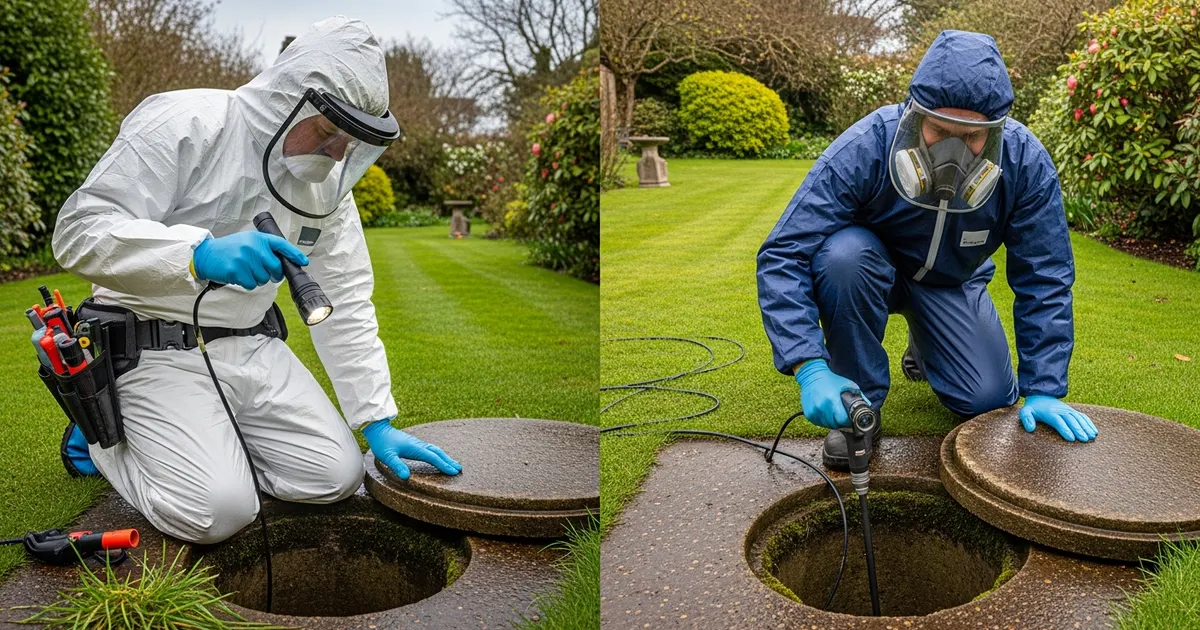
3. Manhole-by-Manhole Inspection
We lift every cover and inspect for signs of rat traffic: smear marks on chamber walls at characteristic rat-height (30 to 50mm above the benching), disturbed sediment, or physical damage to pipework at manhole entry points.
Our standard CCTV drain survey produces a WRc-coded report identifying every defect and its severity. For a suspected rat-ingress investigation we will usually include a specific recommendation on which defects are most likely to be the active route.
Fixing the Entry Point
Once the defect is identified, the repair depends on what it is.
Capped Branches
The most common entry point on older Liverpool housing. When a scullery, outside WC or ground floor kitchen was removed decades ago, the branch drain was often sealed with a single clay stopper or a rough cement cap. These fail over time. The fix is to excavate, properly cap with a modern sealed fitting, or remove back to the parent pipe and patch.
Broken Sections
Cracks, fractures or collapsed pipework are usually fixed by either short localised patch repair or full relining of the affected section. For most garden runs with a single fracture, patching is quicker and less disruptive than excavation.
Displaced Joints
Where a joint has opened enough to admit rats, relining seals the entire run with a continuous inner sleeve and closes every joint. Our pipe relining service is the least disruptive option where excavation would mean lifting a patio or driveway.
Open Gullies and Stack Tops
An open surface water gully with a missing or broken grate should be fitted with a new cast iron or plastic grate. An uncapped or poorly capped soil stack top — particularly on disused or converted chimneys — should be properly sealed.
One-Way Valves
For properties where the defect is on the public side and United Utilities is responsible for repair, but the homeowner wants immediate protection, a one-way non-return valve fitted on the property's lateral drain prevents rats moving upstream. This is a proven, code-compliant solution used by pest control specialists across Merseyside. We fit these regularly in older properties around Walton, Birkenhead and Bootle.
Excavation vs Lining for Rat Entry Repairs
The choice between excavation and lining depends on access, the nature of the defect, and cost. We covered this in detail in our guide to pipe relining vs excavation, and the same logic applies to rat entry repairs. In summary:
- **Lining** closes every joint and seals minor defects over a 10-to-30-metre run in a single day. It is ideal for older clay drains with multiple suspect points.
- **Excavation** is appropriate where the defect is a single well-defined failure (a collapse, an unsealed capped branch, a severely dropped section) and where access is straightforward.
Our drain excavation service handles larger or more complex repairs, particularly where the route is under a shed, driveway or extension added over the original drain line.
Public Health Responsibilities
Under the Prevention of Damage by Pests Act 1949 and the Public Health Act 1936, local authorities have the power to require property owners to remedy conditions that are attracting or harbouring rats. In practice, on Merseyside, environmental health teams at Liverpool City Council, Wirral Council, Sefton Council and St Helens Council will investigate reports and can serve notices requiring repair of defective drainage.
If you rent your property, your landlord is responsible for structural repairs including drains. If you are a freeholder, the responsibility is yours unless the drain falls outside your boundary, in which case it is usually United Utilities' — see our guide to drain ownership in Merseyside for the detail.
A Typical Merseyside Job
A recent job in Liverpool illustrates the full process. The customer had scratching behind a ground floor WC in a 1920s semi. Pest control had laid bait for six weeks with continuous consumption. A CCTV survey found a capped branch under the rear extension — the original scullery waste, sealed badly in the 1970s and now cracked open. We excavated 1.2m down, cut the branch back to the parent pipe, fitted a proper end cap with a double seal, backfilled and reinstated. Pest control reported bait consumption stopped within 10 days. Two years on, no return.
This is the outcome to expect from a proper drainage fix. Pest control alone, without addressing the drainage route, would have been an ongoing monthly cost with no end date.
When to Call
If you have heard scratching, seen droppings, or had pest control confirm rat activity, do not treat this as a rodent problem — it is a drainage problem with a rodent symptom. request a quote online for a CCTV survey and we will identify the route and quote for the permanent fix. We cover Liverpool, Bootle, Walton, Crosby, Huyton, Kirkby, St Helens, Widnes, Birkenhead and the wider Wirral for rat-ingress investigations, usually within 24 to 48 hours of booking.