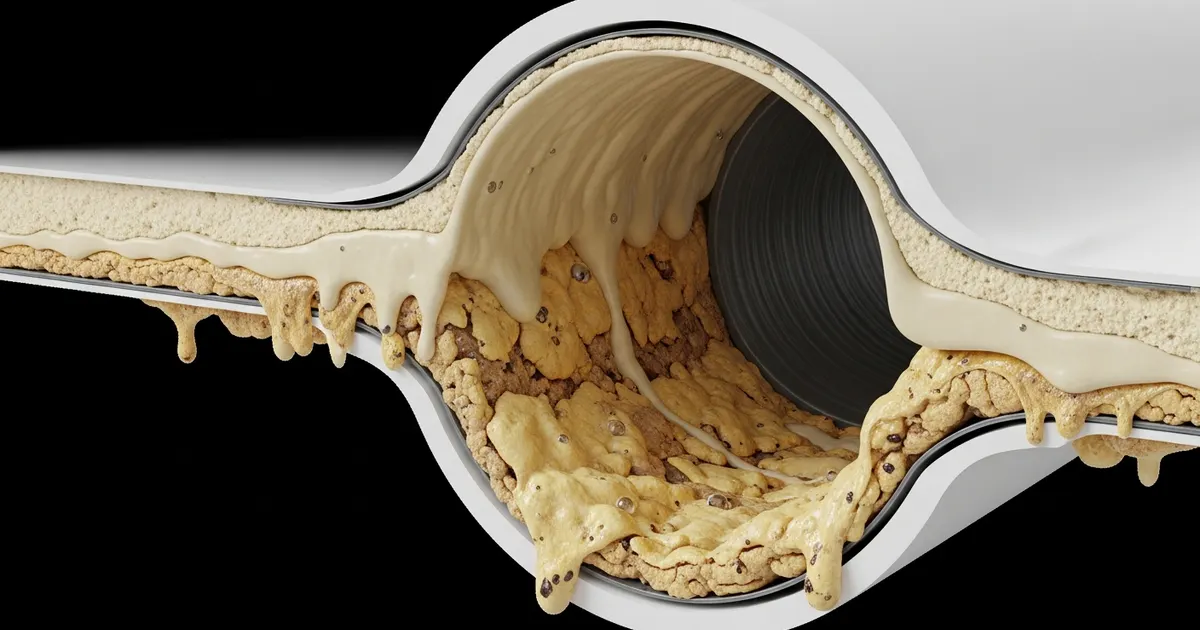
Fat in a kitchen drain is not simply something that washes away. It is a slow, cumulative process that builds a coating on the pipe wall over months and years, progressively narrowing the bore until a blockage becomes inevitable. At Blocked Drains Liverpool we attend FOG (fats, oils, and grease) blockages week in and week out — in domestic kitchens in Anfield and Kensington, and in commercial premises across the city centre. The science behind why fat blocks drains is worth understanding before you reach for any product on the shelf.
Why Fat Solidifies in Pipes
Cooking fat leaves the pan in liquid form — typically at between 50°C and 180°C. By the time it reaches the U-bend beneath the sink, it has already cooled below 40°C. Lard, dripping, and the rendered fat from bacon or sausages all have melting points above the temperature of a cold domestic drain. They solidify on contact with the pipe wall, leaving a thin waxy film with every pour.
Vegetable oils remain liquid at drain temperatures but are not water-soluble. They form an emulsion in the presence of soap or washing-up liquid, which sounds useful until that emulsion breaks as it cools further down the run. The fat droplets then coalesce and adhere to the pipe wall in a soft deposit.
How the "Fatberg" Process Works
What begins as a thin greasy film accumulates food particles, wet wipes, hair, and soap residue over time. When saponification occurs — the reaction between fat and an alkali — a waxy soap compound forms in the pipe itself. It does not rinse away. It bonds to the pipe wall and to itself, layer by layer.
In Liverpool's older housing stock — from the Victorian terraces of Walton through to the inter-war semis of Crosby — the original clay pipes have a slightly rough internal surface that makes adhesion even easier than in a smooth modern plastic pipe.
What Hot Water and Washing-Up Liquid Actually Do
Hot water re-melts any solid fat deposits near the outlet, and washing-up liquid emulsifies the softened fat so it is temporarily carried downstream. The drain flows freely for a few hours or a few days. The problem is that the fat has not been removed from the drainage system — it has been moved further down it, where the water temperature drops sharply and the fat resolidifies.
Why Caustic Drain Cleaners Fail on Fat
What caustic products actually do to a fat deposit is trigger saponification: they convert the fat into a hard soap compound. If that compound is not immediately flushed clear, it re-adheres to the pipe wall in a harder, denser form than it started.
We regularly attend blockages where a customer has poured caustic products into a grease-affected drain several times without success. It requires mechanical removal — high-pressure jetting through our drain jetting service — rather than any further chemical treatment.
What Enzyme Treatments Do — and Their Limits
Biological enzyme treatments introduce live bacterial cultures that secrete lipase, the enzyme that breaks down fat into glycerol and fatty acids. Used consistently, typically weekly, they make a measurable difference to grease accumulation. But enzyme products are a maintenance tool, not a clearance tool. A drain that already has a significant fat blockage will not be cleared by enzyme treatment in any useful timeframe.
The Commercial Dimension: Liverpool's Takeaway Density
Liverpool city centre and its inner suburbs have one of the highest concentrations of food businesses per head of any English city outside London. Bold Street, Lark Lane, the Baltic Triangle, and the takeaway-dense streets around Bootle and Huyton generate FOG in quantities that overwhelm domestic-scale pipe runs.
Commercial premises are legally required to fit a grease interceptor between the kitchen drainage and the foul sewer. When a grease interceptor overflows or is bypassed, the fat goes directly into the shared drainage — something we expanded on in our guide to United Utilities sewers in Merseyside.
Our commercial jetting service is designed for exactly these situations: high-pressure clearing of grease-affected commercial drain runs, with the documentation needed to demonstrate compliance if challenged.
Proper Prevention
**Cool it and bin it.** Rendered cooking fat should be poured into a container, allowed to solidify, and put in the general waste bin.
**Wipe before washing.** Roasting trays and frying pans should be wiped with kitchen paper before going into the sink. A few seconds with a piece of kitchen roll removes 90% of the fat before it ever reaches the drain.
**Fit a drain strainer.** A stainless steel mesh strainer over the kitchen sink outlet catches food particles before they enter the drain.
**Use enzyme treatment as maintenance.** Once a week, pour a measured dose of biological enzyme product down the kitchen drain, follow with warm water, and leave it overnight.
If your kitchen drain is already running slowly, do not wait for it to block completely. A drain jetting visit while the pipe still has some flow is a straightforward hour's work. To book a drain cleaning visit anywhere in Merseyside, request a quote online from Blocked Drains Liverpool. We operate fixed-price callouts with no hidden charges.