Drain descaling is a term that comes up regularly in commercial drain maintenance and less often in residential discussions, which reflects the pattern of where scale becomes a serious problem. Understanding what scale is, how it accumulates, and what the options are for removing it helps premises managers and homeowners alike make better decisions — and avoid confusing it with grease blockage or root ingress, which require entirely different approaches.
At Blocked Drains Liverpool we carry descaling equipment on commercial-equipped vans and conduct descaling work across Merseyside in care homes, schools, commercial kitchens, and industrial premises.
What Scale Actually Is
Scale in drainage systems is primarily calcium carbonate — the same compound that furs kettles and shower heads. It precipitates out of water when carbonate-laden water changes temperature, pressure, or pH. Merseyside's water hardness is typically rated as moderate — broadly in the 150–200 parts per million range, lower than southeast England but meaningfully above soft-water areas. Over a decade of continuous use in a commercial kitchen, that moderate hardness produces a scale layer you would notice.
Scale is hard, brittle, and adheres firmly to the pipe wall. Under CCTV, scale appears as a white or cream deposit narrowing the pipe bore uniformly, whereas grease appears as dark, lobular deposits often hanging from the crown of the pipe. The treatment is different for each.
Where Scale Accumulates
**Urinal waste pipes** are the single most common descaling job we attend. Uric scale (magnesium ammonium phosphate) is extremely hard and accumulates rapidly in urinal trap necks. Unmanaged, a urinal waste can go from full flow to complete blockage within 18 months in a busy premises.
**Commercial kitchen drains** — where a kitchen is running continuous hot water through stainless steel prep sinks, the outlet pipe often carries both a grease layer on the pipe crown and a scale layer on the invert.
**Older residential pipework** — in Liverpool properties in Walton, Wavertree, and parts of the Wirral, kitchen sink waste pipes can carry a scale skin after 20 to 30 years of continuous use, reducing the pipe's self-cleaning capacity.
How Scale Is Removed
Chemical Descaling
Acidic descaling agents are circulated through the affected pipework or introduced as a solution and left to dwell. The acid reacts with the calcium carbonate, converting it to soluble calcium salts that can be flushed away. For urinal waste pipes on service contracts, a proprietary descaling tablet installed in the urinal inlet continuously doses mildly acidic solution to prevent scale accumulating.
Rotary Descaling
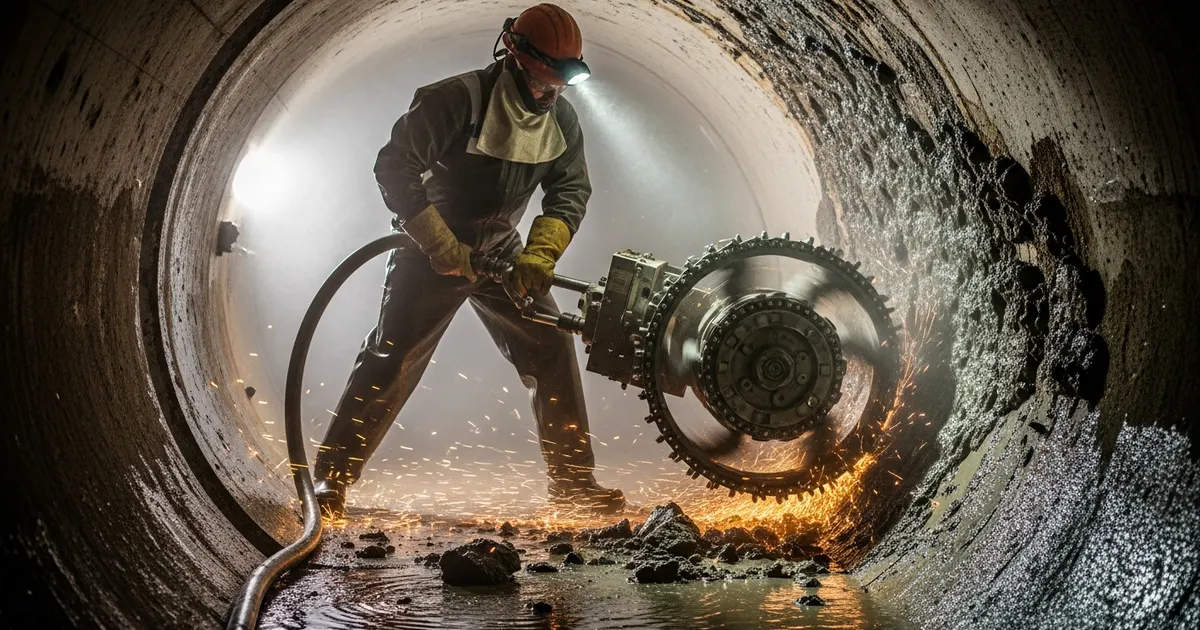
Rotary descaling heads — chains or cutting blades mounted on a flexible drive shaft — are inserted into the drain and rotated at high speed, impacting the pipe wall and knocking scale free. This is the mechanical approach for severe scale and is what we use on urinal stacks that have been left unserviced for years.
Rotary descaling requires care in older pipework. Scale in a clay pipe is sometimes the only thing holding the pipe structure together — removing it too aggressively can fracture the host pipe. A CCTV drain survey before descaling is good practice on any pipe of unknown age.
High-Pressure Water Jetting
High-pressure drain jetting is effective on moderate scale and on the loose scale debris produced by prior rotary descaling. Jetting alone will not remove hard, firmly adhered calcium carbonate scale — but as a follow-up to rotary descaling, it clears loosened debris and restores the pipe to full bore.
Descaling vs Drain Jetting: The Important Distinction
Standard drain jetting clears organic debris: grease, hair, paper, roots. It does not remove firmly adhered mineral scale. A premises that is jetted regularly for grease but never descaled will eventually find the scale occlusion progressing behind the clean grease surface.
For residential properties, the question of descaling arises far less often — most residential drain blockages in Liverpool are caused by grease, fat, hair, wipes, or tree roots. Our guide to blocked drains: DIY vs professional covers the residential decision tree in more detail.
Typical Applications and What Drives the Cost
**Urinal descaling:** the cost depends on how far the scale has progressed — a single stack with moderate scale is a smaller job than a severely occluded waste that needs rotary descaling followed by jetting.
**Commercial kitchen drain descaling:** rotary descaling of main kitchen runs plus jetting scales with the length of pipe run involved.
**Schools and care homes:** a planned descaling visit covering the full premises depends on the number of outlets and the extent of scale across the site.
If you manage a commercial or institutional premises in the Merseyside area and you are unsure whether your drainage needs descaling, grease treatment, or standard maintenance jetting, request a fast, fixed-price quote online from Blocked Drains Liverpool. We will carry out an initial CCTV inspection to establish what is actually in the pipe before recommending a treatment, and we quote on the basis of what we find.