For a domestic customer, drain jetting is something you do when a blockage will not clear with rods. For a commercial operator in Merseyside, jetting is something you do on a schedule, whether or not the drains appear to be struggling. The difference is not cosmetic. It is the gap between a reactive household cost and a documented compliance obligation that Environmental Health inspectors, insurers, and United Utilities all take an interest in.
This guide sets out what the rules actually require of a food, care, or manufacturing business operating out of premises in Liverpool, St Helens, Widnes, or anywhere else on the Mersey basin, and what a sensible jetting regime looks like in practice.
Where the Obligation Comes From
There is no single "drain jetting law." The obligation is assembled from several sources, and Environmental Health Officers (EHOs) apply them collectively.
Fats, Oils and Grease (FOG)
Under Section 111 of the Water Industry Act 1991, it is an offence to discharge any matter into a public sewer that is likely to damage the sewer, interfere with the flow, or affect treatment. United Utilities interprets this clearly: fats, oils and grease poured down a sink, or allowed to accumulate in a drain run, constitute an offence. The penalty can run to prosecution and an unlimited fine, and the operator — not the landlord, not the drain company — is liable.
Food Safety and Hygiene Regulations 2013
Regulation (EC) No 852/2004, enforced in England through the 2013 regulations, requires food premises to have "adequate drainage" that does not pose a risk of contamination. "Adequate" in EHO practice means drainage that is not blocked, not backing up, not producing odour, and is maintained in a way the operator can evidence.
Public Health Act 1936
Older legislation, still in force, allows local authorities to require private drains be cleaned or repaired where they are causing or likely to cause a nuisance. A restaurant in Bold Street or a takeaway in Bootle with drains backing into the yard will receive a notice under this Act rapidly, and non-compliance escalates to a magistrates' court order.
Your Insurance Policy
This is the compliance piece many operators overlook. Commercial property and business interruption policies almost universally contain a "reasonable care" clause. If a grease-blocked drain causes a sewage flood that damages a kitchen, and the insurer can show there was no recent jetting, no grease trap maintenance, and no CCTV records, the claim is often repudiated. Read your policy wording — it will refer to "maintenance in accordance with good commercial practice," and that phrase is where jetting schedules live.
Grease Trap Requirements
A grease management device — gravity grease trap, grease recovery unit, or biological dosing system — is effectively mandatory for any premises producing hot food. United Utilities' Trade Effluent Consent process treats a food business without grease management as non-compliant by default.
The two things EHOs check are:
- **Sizing.** The device must be sized to peak flow and to actual grease load. A 35-litre under-sink trap on a 120-cover restaurant is not compliant even if it is clean.
- **Servicing records.** A logbook showing emptying and cleaning at least monthly for a busy kitchen, with contractor invoices. A trap on paper only is worthless.
Between traps and the public sewer, the pipework itself still accumulates grease. A trap captures the majority, not all. This is why even well-maintained food premises need their external drain runs jetted commercially on a schedule.
Typical Jetting Schedules
There is no statutory interval, but the following reflects what we recommend across our commercial customers in Merseyside, and what insurers and EHOs treat as reasonable:
- **High-volume restaurants and takeaways** (60+ covers or fryer-heavy operations): every 3 months, plus reactive calls.
- **Pubs with kitchens and cafes:** every 6 months.
- **Care homes and nursing homes:** every 6 months, with additional attention to macerator and wet-room runs.
- **Schools and nurseries:** annually, timed to summer holidays.
- **Food manufacturers and bakeries:** quarterly at minimum, often monthly for high-yield fat producers.
- **Office blocks and retail:** annually is usually sufficient.
For a restaurant on Castle Street or Hope Street, or a takeaway parade in Huyton or Kirkby, quarterly jetting is neither excessive nor unusual. We jet under kitchen extractors, through floor gullies, and along the full run to the public sewer connection.
For the underlying mechanism of how jetting removes grease and debris where rodding cannot, see our guide to drain jetting versus drain rods.
What Environmental Health Inspectors Look For
When an EHO visits a food premises, the drainage part of the inspection follows a predictable pattern:
- **Visible drains.** Are floor gullies clean and flowing, or ponded? Is there standing water under sinks?
- **Odour.** A "sewer smell" in food prep areas is an automatic non-compliance finding.
- **Grease trap.** They lift the lid. They want to see a clean trap, a clean strainer, and a logbook.
- **Records.** Servicing invoices for the last 12 months. Jetting reports. Any CCTV reports if repair work has been done.
- **Pest evidence.** Rats and drains go together; an EHO seeing rat evidence will ask about drain condition immediately.
The inspection outcome feeds into the Food Hygiene Rating Scheme. Dropping from a 5 to a 3 rating because of drainage hygiene findings has a measurable impact on trade in a city like Liverpool where customers routinely check ratings.
CCTV Logs as Compliance Evidence
The most useful thing we do for commercial customers — and the most undervalued — is supply a CCTV survey alongside annual or biannual jetting. The logic is straightforward:
- Jetting cleans the drain. CCTV proves the drain is clean after jetting.
- The survey catches early structural issues (open joints, minor root ingress, pitch fibre deformation on older premises) before they become floods.
- The report and video become part of your compliance file, usable for insurance and EHO evidence.
For older commercial premises in Walton or Liverpool city centre, where drains are often shared with neighbouring properties and where pitch fibre and salt-glazed clay are common, the CCTV record is particularly valuable. A problem documented as "pre-existing, monitored" is very different to one discovered after a flood.
We also see CCTV records used offensively: when a neighbour's drainage causes a problem on your premises, dated CCTV footage is the difference between a quick resolution and months of dispute.
What a Commercial Jetting Visit Involves
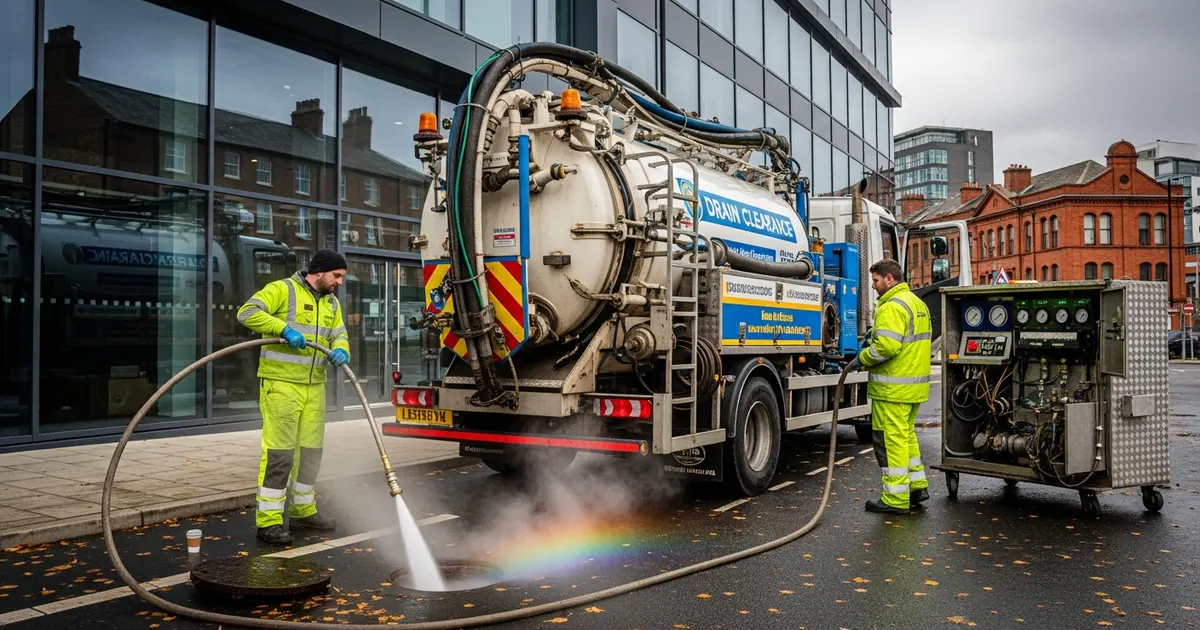
For a typical food premises visit we schedule a time outside service hours — early morning for a restaurant, late evening for a bakery. The work is:
- Isolate internal fixtures and flush.
- Jet the internal stack and branch drains.
- Lift external manholes and jet the site run to the adopted sewer.
- Camera the run to confirm condition.
- Issue a written report with footage, recommendations, and the next service date.
A typical 60-cover restaurant in Birkenhead or central Liverpool takes 3 to 4 hours. Care homes with larger footprints often take a full day.
The Cost of Compliance vs the Cost of Failure
The cost of a scheduled quarterly jetting contract depends on the size of the kitchen and the drainage network it serves. Set against that is the cost of a single grease-related sewer flood — a closure, a refit, an insurance dispute, a hygiene rating drop — which escalates quickly and dwarfs the cost of routine maintenance. The commercial maths is unambiguous. Request a fast, fixed-price quote online for your premises.
For premises with persistent blockages that cannot be resolved with jetting alone, the diagnosis often points to structural pipe failure, and the fix moves into drain unblocking followed by CCTV-directed repair.
Blocked Drains Liverpool runs commercial jetting contracts across Merseyside for restaurants, care groups, schools, and food manufacturers. We provide fixed-price annual schedules, out-of-hours work, and full documentation for insurance and EHO purposes. Request a quote online to discuss a schedule that fits your operation.