Drain excavation has a reputation for disruption, cost, and uncertainty. It is the option most homeowners hope they will not need, and when an engineer recommends it, the reaction is often anxiety rather than acceptance. That anxiety is almost always worse than the reality, because drain excavation — when properly planned and executed — is a methodical, well-understood process with a predictable sequence of events and a defined end state.
At Blocked Drains Liverpool we carry out drain excavations across Merseyside throughout the year, from domestic back-garden jobs lasting a single day to footpath and road crossings requiring Section 50 licences and traffic management. This guide walks through the complete process so that if you are facing an excavation job you know exactly what to expect.
Step 1: Survey Confirmation — Why Excavation Is the Right Remedy
Excavation is not the first response to a drain problem. Before any responsible drainage company recommends digging, the defect should be confirmed by CCTV drain survey. The survey establishes the exact nature of the defect, its precise location and depth measured from the nearest manhole, the pipe material, and the condition of the surrounding section.
From the CCTV report we determine whether relining is a viable alternative. If the pipe is collapsed, severely displaced, or has a belly that cannot be corrected by lining, excavation is the only option. We covered the relining versus excavation decision in our post on pipe relining vs excavation.
Step 2: CAT Scanning for Buried Utilities
Before any ground is broken, the excavation zone must be scanned for buried services using a Combined Avoidance Tool (CAT) scanner, which detects electromagnetic signals from metallic cables, gas pipes, and water mains buried in the ground. For private garden excavations, the typical services to locate are electrical supply cables, gas service pipes, water supply pipes, and BT/Openreach ducts.
CAT scanning is not optional — any contractor who starts excavating without it is operating in breach of HSG47. At Blocked Drains Liverpool we carry CAT equipment on every van and will not break ground without a completed scan.
Step 3: Section 50 Licences and Road or Footpath Permits
If the excavation extends beyond the boundary of the private property onto a public footpath, verge, or carriageway, a Section 50 licence under the New Roads and Street Works Act 1991 is required before work begins. This licence is issued by the local highway authority and sets out the conditions for opening the highway, the reinstatement standard required, and the traffic management measures needed.
The majority of domestic excavations we carry out in Liverpool and across Merseyside are entirely private property jobs and involve no highway works at all.
Step 4: Setting Up the Work Area
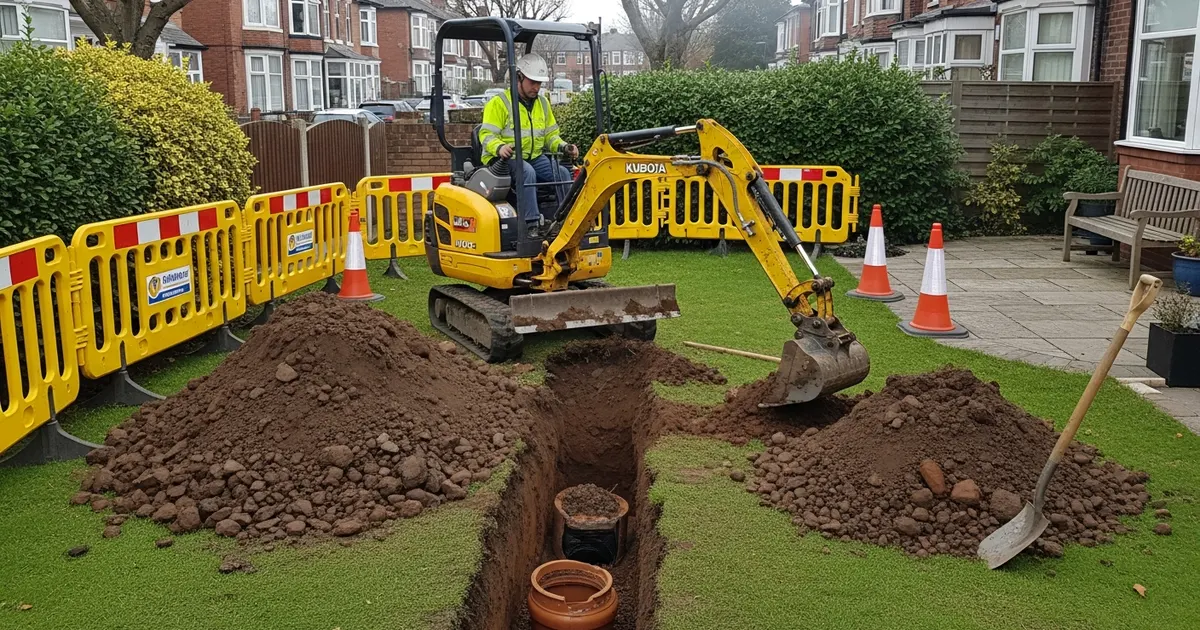
Work area set-up takes 20 to 30 minutes: marking out the excavation footprint, laying protective sheeting or boards on garden areas, setting up edge protection with excavation boxes and safety barriers, and positioning the spoil storage area. On a typical domestic rear-garden job, the excavation footprint to access a defect at 1 to 1.5 metres depth is usually 1.5 to 2 metres long and approximately 600mm to 800mm wide.
Step 5: Excavation and Shoring
The excavation is carried out by hand on shallow domestic jobs (under 1 metre) or with a combination of machine and hand digging on deeper runs. For depths between 1.2 and 1.5 metres, excavation boxes (Trench Shields) are installed as the dig proceeds to provide safe working conditions. For depths greater than 1.5 metres, stepped excavation or additional shoring is required under the Excavations Regulations.
In Merseyside, much of inner Liverpool and the dock-side areas of Bootle and Birkenhead sit on variable fill and made ground above the natural boulder clay. This fill can be unstable and contain voids. Our engineers are trained to recognise changed ground conditions and adjust shoring accordingly.
Step 6: Pipe Removal and Material Disposal
Once the defective pipe is exposed, it is removed in sections. If the pipe contains live sewage, the excavation area is managed hygienically and the exposed ends are temporarily plugged.
Removed pipe material is classified under waste regulations. Clay and concrete pipe is inert waste. Pitch fibre pipe requires more careful handling as some early formulations contain asbestos binders — our team treats pitch fibre removal with appropriate caution and disposes of it through a licensed facility.
Step 7: New Pipe Installation to BS EN 1610
The new drain section is installed to the requirements of BS EN 1610:
**Pipe bedding.** Granular bedding material (typically 10mm pea gravel) is compacted to form a uniform, continuous bed for the pipe barrel.
**Gradient.** The gradient of the new section must be at least 1:80 for a 100mm diameter drain. The CCTV survey will have established the gradient of the existing run; the new section must match or improve it.
**Joint sealing.** Rubber ring push-fit joints are standard for new uPVC drainage. Where the new section connects to existing clay pipe, an adaptor coupling provides the transition.
**Surround.** After laying and jointing, the pipe is surrounded with granular material to at least 150mm above the crown before selected backfill is placed on top.
Step 8: Backfill and Compaction
Backfill is carried out in layers — typically 150 to 200mm compacted lifts — using a vibrating plate compactor on each layer before the next is placed. Inadequate compaction is one of the most common causes of surface settlement over a repaired drain.
Step 9: Surface Reinstatement
**Garden topsoil and turf.** Topsoil is replaced, seeded or turfed to match the surrounding lawn. We always strip and retain topsoil separately before excavating so it can be replaced correctly.
**Block paving.** Existing block pavers are lifted, stored, and relaid after backfill. Blocks rarely need replacement unless damaged during excavation.
**Highway reinstatement.** Where a Section 50 licence applies, reinstatement must comply with the Specification for the Reinstatement of Openings in Highways (SROH), Version 3, with a 2-year inspectable guarantee period.
Timescales and Cost
A typical domestic drain excavation — access a single defect at 1 to 1.5 metres depth, replace a 2 to 3 metre section of pipe, reinstate with topsoil and seed — takes one working day. More complex jobs typically extend to two days. Excavation costs are based on the depth and length of the excavation, the surface to be reinstated, and any special circumstances (shoring, permit costs, contaminated spoil disposal). We provide a written fixed price before any work begins.
To get a drain excavation quoted for a property in Liverpool, Bootle, Walton or anywhere across Merseyside, request a quote online from Blocked Drains Liverpool. We will review the CCTV report, confirm the scope, and give you a written fixed price — with a clear explanation of what will happen on each day of the job — before we schedule a start date.