In Liverpool, shared drain disputes are more common than anywhere else in our coverage area. That is not a coincidence. The city's housing stock is dominated by Victorian terraces — streets of tightly packed houses built over shared underground drainage that was never designed to be anyone's individual responsibility. When something goes wrong, the question of who owns the problem is rarely simple.
This guide explains the legal framework as it currently stands, the practical steps for identifying your drain boundary, and what happens when neighbours cannot agree.
The 2011 Sewer Transfer: What Changed
Before October 2011, the boundary between private and public drainage in England and Wales was the external wall of a property. Everything beyond that wall — the drain run from your house to the sewer in the street — was your responsibility, regardless of whether it was shared with a neighbour.
The Water Industry (Schemes for Adoption of Private Sewers) Regulations 2011 changed this fundamentally. From 1 October 2011, the majority of private sewer pipes that had previously been jointly maintained by multiple households were transferred to the ownership of the relevant water company — in Merseyside, that is United Utilities.
In practical terms, this means that a drain serving more than one property — a lateral drain running from a back entry and collecting the foul water from two or more houses before connecting to the public sewer — is now owned and maintained by United Utilities. If it blocks, United Utilities fix it. If it collapses, United Utilities repair it. At no cost to the householder.
This was a significant shift, and many Liverpool homeowners — and some drainage companies — are still unaware of it. If someone quotes you for work on a drain that turns out to be adopted public sewer, you should not be paying for it.
What United Utilities Is Now Responsible For
United Utilities is responsible for:
- The public sewer network, including all adopted lateral drains as transferred in 2011.
- Any drain that serves two or more properties beyond the point where the individual connections join.
- Shared back-entry drains running beneath communal passages in terraced rows.
- The inspection chambers and manholes on adopted drain runs, even if those chambers are within a private garden.
United Utilities has a 24-hour emergency line and will attend blockages and failures on adopted drains at no charge. Their coverage and the specific nature of the 2011 transfer is explained in our guide to United Utilities sewers in Merseyside.
What Remains Your Responsibility
The transfer did not adopt everything. You remain responsible for:
- The drain run from your property to the point where it either connects to a public sewer directly or joins a shared lateral drain.
- Any drain that serves your property exclusively, regardless of its position on your plot.
- Gullies, inspection chambers, and pipework within your property boundary that drain only your property.
- Internal pipework — soil stacks, waste pipes, and appliance connections within the building.
The critical concept is exclusivity. A drain serving only one property is private, regardless of where it is. A drain serving more than one property is shared and, in the vast majority of cases, adopted by United Utilities under the 2011 transfer.
How to Identify Your Drain Boundary
The most reliable way to establish where your private drain ends and the adopted sewer begins is to check the United Utilities sewer records — the public sewer map, which can be requested from United Utilities directly or inspected via their customer portal.
For properties in Liverpool's Victorian terraces, the shared drain often runs through the back entry and connects to a public sewer beneath the street at the end. The section running through the back entry may be adopted; the section running from your rear yard to the back entry is almost certainly private.
If the sewer map is ambiguous, a CCTV drain survey with a report referenced to the map is the definitive answer. We carry out these surveys across Bootle, Walton, Kirkby, and across Merseyside.
When the Problem Is in the Shared Private Section
Not every shared drain was adopted in 2011. Some drain runs that serve multiple properties remain in private shared ownership — most commonly where the transfer criteria were not met or where the pipes were in very poor condition at the transfer date.
In these cases, the cost of repair falls on the owners of the properties served by that drain, typically in equal shares. The legal position is broadly that each property owner is responsible for their proportionate share of the cost of maintaining a shared private drain.
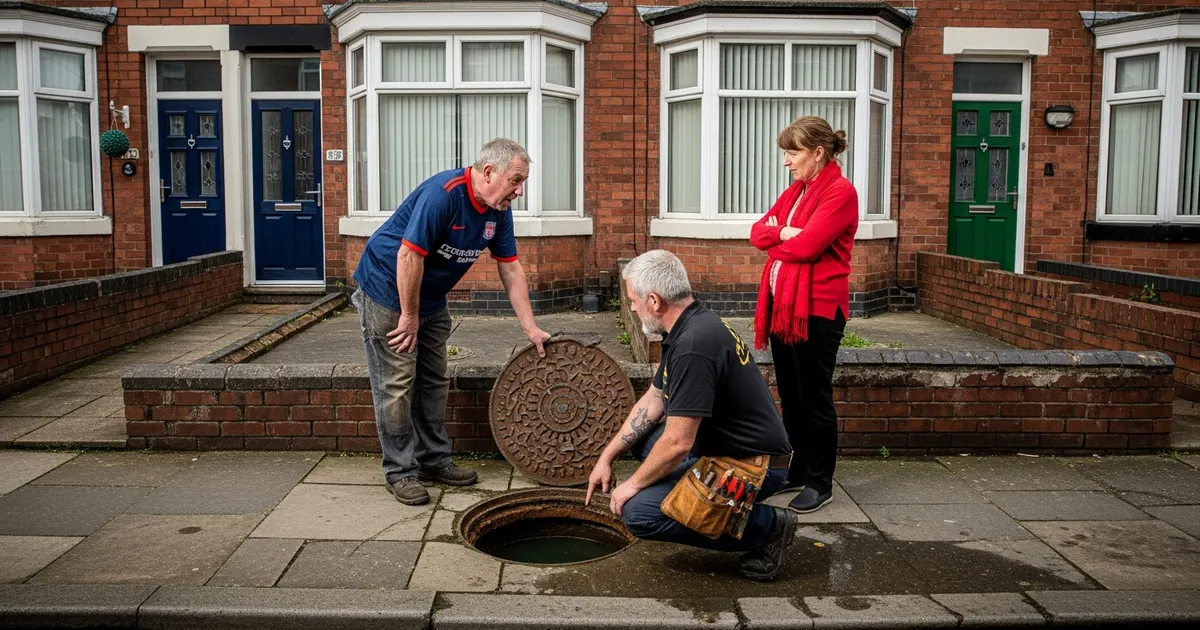
Disputes Between Neighbours
The practical advice for shared drain disputes in Liverpool and Birkenhead:
**Establish first whether the drain is adopted.** If it is United Utilities' problem, neither household pays. Call United Utilities before engaging a private contractor for any work on a shared run.
**If it is a shared private drain, agree to share costs before work starts.** Get this in writing — a simple text or email exchange is usually sufficient.
**Get a CCTV drain survey first.** Where exactly is the blockage? Is it in your section or your neighbour's? A survey with a written report costs a fraction of what legal advice costs and gives both parties a factual basis for discussion.
The Victorian Terrace Context
Liverpool's terraced housing was built largely between 1850 and 1910 across the inner suburbs — Everton, Toxteth, Kensington, Anfield, Walton, Crosby, and Huyton. Many of these shared drain runs are still the original clay pipes — now well over a century old with opened joints, partial collapses, and groundwater infiltration.
The back entry drain that serves a row of six terraces in Walton and was adopted by United Utilities in 2011 is United Utilities' infrastructure to repair. The drain from each rear yard to the entry is each householder's individual responsibility. Knowing which is which before a problem arises is the most useful single piece of knowledge any Liverpool terrace owner can have.
If you need to identify your drain boundary, resolve a dispute, or simply get a clear picture of the drainage beneath your property, Blocked Drains Liverpool can carry out a CCTV survey with a written report that maps the run against the United Utilities sewer map. Request a quote online — we cover all of Merseyside and provide fixed-price quotes with no call-out fee. Our drain surveys service includes a full written report in the format accepted by insurers and solicitors.