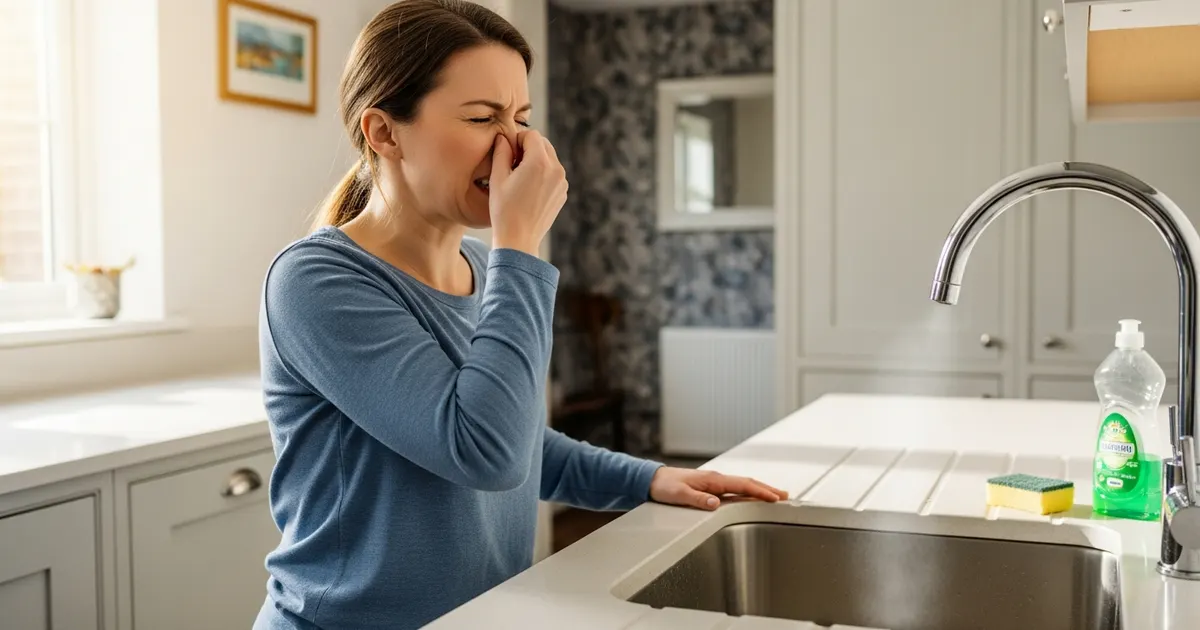
Bad drain smells are one of the most common complaints we hear from homeowners across Merseyside. They are also one of the most misdiagnosed. The instinctive response — pour something caustic down the drain and hope for the best — addresses precisely none of the underlying causes and can make a professional's job harder when the problem turns out to be structural. This guide explains what is actually producing the smell, what you can fix yourself, and what needs a drainage engineer.
The Four Categories of Drain Smell
Not all drain smells come from the same place or signal the same problem. Before you reach for a bottle of drain cleaner, it helps to understand which category you are dealing with.
1. Trap Evaporation
Every plumbing fixture — sink, bath, shower, toilet — has a trap: a U-bend that holds a small volume of water as a permanent seal against sewer gases. When a fixture is not used for a long period, that water evaporates. The seal disappears, and sewer gas — which contains hydrogen sulphide, ammonia, and methane — rises freely into the room.
This is the simplest and most frequently overlooked cause of drain smells, and it is particularly common in Liverpool's older Victorian terraces where properties have been left empty between tenancies, where a second bathroom is rarely used, or where a property has stood vacant for any length of time. The fix is simply to run water into every trap in the building — including toilets, which should be flushed — and then add a tablespoon of cooking oil to the drain in any trap you know will not be used again for weeks. The oil floats on the trapped water and greatly slows evaporation.
2. Partial Blockage
A partial blockage holds organic matter — food residue, hair, soap, grease — in the drain where it decomposes slowly. This produces a localised smell that is typically strongest directly at the drain opening and worsens after hot water is run, which volatilises the decomposing material.
Partial kitchen blockages nearly always involve fat and food. Bathroom partial blockages nearly always involve hair and soap scum. The smell associated with partial blockages has a distinct organic, rotten quality — noticeably different from the sharper sulphurous smell of sewer gas.
A partial blockage can usually be cleared by hand or with basic tools, and we cover the DIY approach in our guide on drain unblocking cost Liverpool — though the economics quickly favour a professional when the blockage is in the drain run rather than the trap itself.
3. Venting Problems
Every drain system is vented — typically through a soil vent pipe (SVP) that runs up through the building and terminates above roof level. This vent allows air to enter the system to balance pressure, preventing siphoning of trap water when a fixture is used and allowing gases to escape to atmosphere rather than back into the building.
When a vent is blocked (a bird's nest, accumulated debris, a cap that has failed, or — in older properties — a vent that has never been extended high enough above the roofline), negative pressure in the system siphons trap seals and gas enters the building. The symptom is a smell that appears or worsens after a fixture elsewhere in the system is used — the pressure wave from a flushed toilet or a filled bath draining quickly is enough to suck a marginal trap seal dry.
Venting problems are particularly common in Liverpool's Victorian terraced housing. Many of these properties were built before modern venting standards, and the original soil vent pipes — often cast iron, sometimes shared between two properties — have corroded, fractured, or been poorly modified by decades of ad hoc plumbing work. Where a terrace has had loft conversions, the SVP may have been shortened or rerouted in a way that compromises the stack pressure.
4. Structural Drain Defects
The most serious cause of persistent drain smell is a crack, fracture, displaced joint, or other structural failure in the underground drain run. A cracked pipe allows both moisture and gas to escape into the soil and, in some cases, into cavities beneath a suspended floor or through a foundation wall into the building itself.
This type of smell is distinctive — it is strongest at ground level, may vary with ground conditions and wind, and does not respond to any amount of trap cleaning or vent unblocking. In a ground-floor room of a Victorian terrace where the floor is close to the drain run beneath, a cracked pipe a metre below ground can be clearly detectable inside the property.
Only a CCTV drain survey can confirm a structural defect. You cannot diagnose this from above ground.
DIY Fixes That Actually Work
Refilling Dry Traps
Run each fixture until you are certain the trap is full. For a floor drain or a drain that is rarely used, pour in 500ml of water and a tablespoon of cooking oil.
Cleaning the Trap
For a bathroom sink with a slow-clearing partial blockage, remove the trap under the sink (have a bucket ready), clean out the accumulated hair and soap scum, and refit. For a kitchen sink, the same process removes the grease plug that invariably forms in the bend. This takes ten minutes and costs nothing.
Hot Water Flush for Kitchen Drains
For a partial kitchen blockage in the pipe beyond the trap, a kettle of very hot water (not boiling — thermal shock can crack older pipework) followed by a squirt of washing-up liquid repeated twice a day for a few days will often shift a soft grease build-up that is not yet fully blocked. This is not the same as the drain being structurally clear — it is a temporary measure that buys time.
Checking the External Air Admittance Valve
If the property has an air admittance valve (AAV) — a one-way valve fitted in the loft or under-sink space instead of a full soil vent pipe to atmosphere — check that it has not seized. A failed AAV that is stuck closed produces exactly the same symptoms as a blocked vent. These are inexpensive to replace.
What Caustic Cleaners Cannot Fix
Caustic drain cleaners and enzymatic products will not fix trap evaporation, venting faults, or structural defects. For a partial blockage they may soften grease sufficiently to clear a symptom temporarily, but if the blockage is soap and hair in a bathroom, caustic products largely fail — hair does not dissolve readily in standard household caustic formulations.
More importantly, if you pour caustic liquid into a drain and the blockage does not clear, you now have a drain full of corrosive liquid. That drain is now harder and more dangerous for an engineer to work on. We regularly arrive at blocked drain callouts in Liverpool and Birkenhead where caustic products have been poured without effect and the customer cannot understand why the smell has not gone. The answer is usually that caustic products never had any prospect of addressing the actual cause.
When the Smell Means Something Structural
The specific circumstances that indicate a structural drain defect rather than a simple maintenance issue are:
- The smell persists after all traps in the property have been confirmed full and recently used.
- The smell is strongest at floor level rather than at the drain opening.
- The smell is present in rooms with no plumbing fixtures — a hallway, a living room, a bedroom above a ground-floor drain run.
- The smell has emerged following ground movement, a period of very dry weather, or after recent building work nearby.
- Other fixtures in the property are showing signs of a blocked drain — slow drainage, gurgling, or discolouration.
If any of these apply, call an engineer. A CCTV survey will locate the defect and give you a clear picture of the repair options — whether that is a patch liner at a single displaced joint or a longer pipe relining job.
Liverpool-Specific Factors
Victorian terraced properties across Walton, Wavertree, Kensington, Anfield, and Toxteth commonly share drain venting arrangements between adjacent properties. A fracture or displacement in a shared soil stack can produce smells in one property from gas originating in a neighbour's drain — which makes the source extremely difficult to trace without a camera.
In properties where back-to-back terraces share a rear entry, there are often inspection chambers beneath the entry itself that serve both rows. These chambers are sometimes cracked, undermined, or have poorly-fitting covers that allow gas to escape at ground level and enter through any nearby air bricks or floor voids.
If you have investigated all the obvious causes and the smell persists, the most efficient next step is a survey rather than further trial and error. Blocked Drains Liverpool carries out CCTV surveys across Merseyside with a full written report identifying any structural defects and the remedial options. Request a quote online — we cover Liverpool, Bootle, Crosby, and all surrounding areas, and we provide a fixed price before any work starts.