Drainage-related insurance claims are among the most contested a homeowner will ever make. The sums involved — subsidence, escape of water, flooding, consequential damage — can run into tens of thousands of pounds, and loss adjusters are trained to look closely at the evidence before a claim is paid. A CCTV drain survey carried out and reported correctly can be the difference between a paid claim and a rejection letter.
At Blocked Drains Liverpool we produce survey reports every week that are submitted to insurers, loss adjusters and solicitors across Merseyside. This guide sets out what a claim-grade survey looks like, what insurers actually require, and the common pitfalls that lead to claims being turned down.
The Claims Most Often Supported by a Drain Survey
Subsidence
By far the most common. If movement has been detected in the house — cracks in brickwork, sloping floors, sticking doors — the insurer will want to know whether defective drainage is a contributing cause. A leaking clay drain under a property can wash out the supporting subsoil over years, particularly in the shrinkable clay belt that runs through parts of Knowsley and Huyton.
The insurer will commission, or ask you to commission, a CCTV survey of every drain within about five metres of the affected wall. The report must identify every defect, its location, and its likely contribution to ground movement.
Escape of Water (Consequential Damage)
If a drain has leaked foul water under a floor or into a wall cavity, the damage to plaster, flooring and timbers is often covered under the escape of water section of a buildings policy. The policy usually excludes the cost of repairing the drain itself — but covers everything it damaged. A survey identifying the leak point and dating the defect is essential.
Accidental Damage
If a contractor has crushed a drain during an extension or a landscaper has driven a mini-digger over a shallow section, accidental damage cover may pay. The survey must prove the damage is recent, mechanical, and inconsistent with age-related deterioration.
Flooding and Sewage Backup
For claims under the flooding section of a policy, the insurer will want evidence that the drainage was overwhelmed by circumstances outside the homeowner's control — not by a pre-existing blockage that should have been maintained. A survey showing a clear, well-maintained drain at the time of the event supports this.
What Insurers Accept: The WRc Standard
The industry standard in the UK is the Water Research Centre (WRc) Manual of Sewer Condition Classification, currently in its fifth edition (MSCC5). Any survey intended for insurance use must be reported to this standard. That means:
- Defects coded using the WRc coding system (FL, FC, CX, JDL, etc).
- Severity grades (1 to 5) assigned to each defect.
- Structural and service condition grades calculated per pipe length.
- Full manhole reference, pipe material, diameter and depth recorded for every run.
- Continuous distance measurement along each run, with defects located to the nearest 0.1 metre.
A survey that is not WRc-coded is, in insurance terms, not a survey. It is a video with commentary. Many cheaper providers supply the latter and customers are surprised when the loss adjuster rejects it.
What a Claim-Grade Report Must Contain
Every claim-grade report we produce at Blocked Drains Liverpool contains, as standard:
- **A site plan** showing all manholes, drain runs and the survey direction, overlaid on a scaled drawing of the property.
- **A manhole schedule** with diameter, depth to invert, cover type and condition for every chamber.
- **An observation log** for each run, listing every observation with its WRc code, severity grade, distance from start, and a still image.
- **Structural and service condition grades** for each run.
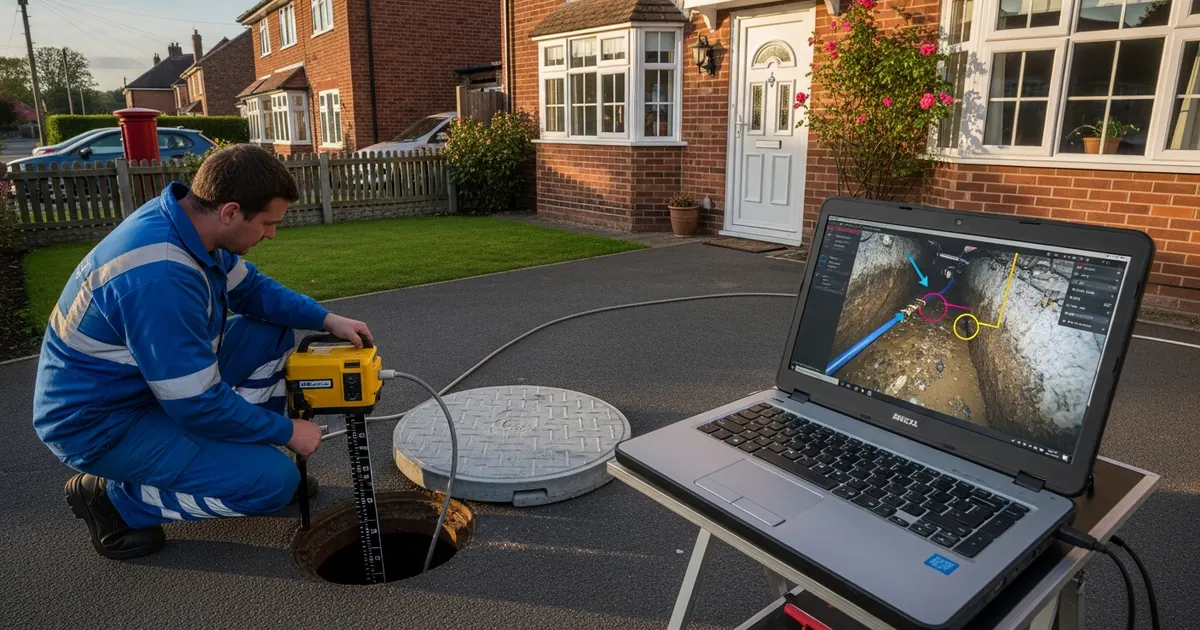
- **Full-length HD video** in a standard format (usually MP4) referenced to the distance counter on-screen.
- **An engineer's summary** identifying the likely cause, age, and recommended remediation for each significant defect.
- **A signed declaration** from the survey engineer, with their qualifications and accreditations (we hold NADC and City & Guilds 6028 qualifications as standard).
Insurers and loss adjusters recognise this format immediately. Reports that deviate from it often trigger a request for a second survey at the policyholder's cost.
Photos and Footage: What the Insurer Actually Wants
Continuous video is the gold standard. The footage must show:
- The manhole cover being lifted at the start.
- Clear, in-focus camera imagery with the distance counter visible on-screen.
- Every defect captured with the camera paused and the position noted.
- The camera head emerging into the next manhole (to prove the full run was inspected).
Still images alone are not enough. We have seen claims rejected because an earlier contractor produced 20 still images with no video to prove the rest of the run was clear.
Common Reasons Drainage Claims Are Rejected
Having sat in on many loss adjuster visits, these are the reasons we see claims rejected:
"Gradual Deterioration"
Most domestic policies exclude damage caused by gradual deterioration. If the survey shows a pipe that is clearly 40 years old with longstanding root intrusion, the insurer will argue the homeowner should have maintained it. The counter-argument — and the one a good survey can support — is that the deterioration only recently reached a point where it caused the insured damage.
"Pre-Existing Defect"
If the survey shows a defect that pre-dates the policy, or that the homeowner knew or ought to have known about, the claim may be rejected. Home-movers are particularly vulnerable here: if you inherited a poor drainage system and did not have it surveyed at purchase, the insurer can argue you took on a known risk. We cover this in detail in our guide to CCTV drain surveys for home buyers.
"Poor Maintenance"
Blockages caused by wipes, fat or misuse are almost always excluded. If the survey shows a drain full of debris consistent with misuse, the escape-of-water claim will fail.
Non-WRc Report
The single most avoidable reason. A survey report that is not coded to WRc standards is often rejected on sight. Make sure before instructing anyone.
Unqualified Surveyor
Some insurers now ask for evidence of the surveyor's qualifications before accepting a report. Reports from untrained operators are increasingly challenged.
When to Commission the Survey
The best time is before you submit the claim, not after the insurer asks for one. Submitting a complete, WRc-graded report alongside the initial claim substantially reduces the chance of the insurer commissioning their own survey (which they have the right to do) and of the claim being delayed for months.
For urgent situations — sewage ingress, active flooding, subsidence showing rapid movement — the priority is stabilisation first and survey second. Our emergency drain services team deals with the immediate issue; our survey team follows up promptly to produce the claim report.
Where We Work On Claim Surveys
We have produced claim-grade CCTV drain surveys for customers, loss adjusters and solicitors across Liverpool, Crosby, Wirral, Widnes and the wider Merseyside area. Most claim surveys are commissioned either by the homeowner directly, by the insurer's panel loss adjuster, or occasionally by a solicitor handling a negligence claim against a builder or neighbour.
Once the survey is complete and the insurer accepts liability, the remedial work — lining, excavation, or patch repair — is typically covered under the policy subject to the usual excess. Our drain repairs team handles the remediation either as the insurer's preferred contractor or, more commonly, as your chosen contractor under a cash-settled claim.
A Final Note on Urgency
If you have a suspected subsidence issue, sewage ingress, or escape of water affecting the structure of your home, do not wait to commission a survey. Evidence deteriorates — repairs, cleaning and the passage of time all make the insurer's job of verifying your claim harder.
request a quote online and we can usually have a surveyor on site promptly, with a draft report back to you within two working days.