The assumption that a new build comes with fewer problems than an older property is understandable but often wrong when it comes to drainage. At Blocked Drains Liverpool we survey new builds across Merseyside with increasing frequency, particularly in the areas of Kirkby and Knowsley where large estate developments have been completed over the past decade. The drainage defects we find are not the result of age or decay — they are construction defects, and the distinction matters enormously when it comes to who is responsible for fixing them.
Why New Builds Have Drainage Problems
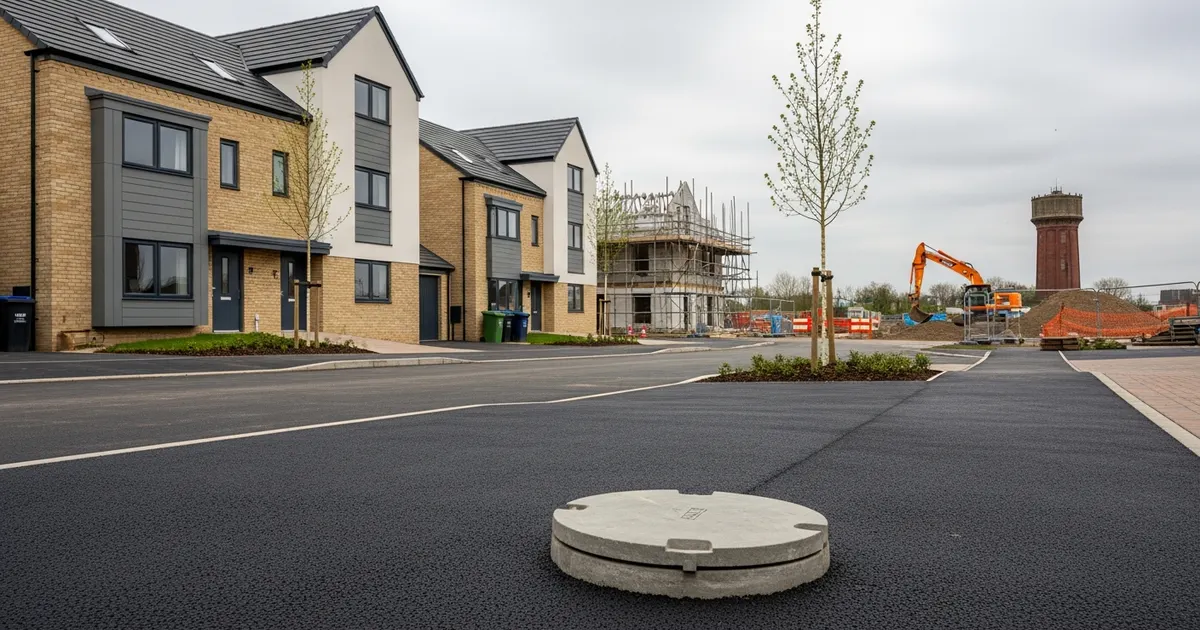
The drainage on a new residential estate is typically installed by a groundworks subcontractor working under time and cost pressure. Drainage trenches are dug, pipes are laid, junctions are formed, and inspection chambers are installed — often while other trades are working on the same plot and plant machinery is moving constantly around the site. The conditions are not ideal for precision work.
The finished result is then covered with backfill material and eventually concrete, tarmac, or turf. Nobody inspects it with CCTV at the end of the groundworks phase — that would delay the build programme. The purchaser has no way of knowing whether the drainage beneath their garden and driveway was installed correctly.
Common Defects Found in New Build Drainage
Inadequate Falls
Foul drainage requires a gradient of at least 1:40 for 100mm pipes to achieve self-cleansing velocity. Where a pipe has been laid with insufficient fall, or where the fall has been reversed by settlement of the surrounding fill material, solids accumulate. The first symptom is a drain that clears slowly; the medium-term result is repeated blockages that cannot be permanently resolved without re-grading the pipe.
Poorly Bedded Junctions
Where a branch drain connects to a main run, the junction needs to be correctly bedded in concrete haunching. If the haunching is absent or incomplete, the junction can displace slightly as the surrounding ground consolidates, creating a partial obstruction inside the pipe.
Gravel-Contaminated Backfill
Contamination of the bedding layer with larger material — broken brick, crushed concrete, or coarse aggregate — is common on busy construction sites. Over time, point loads from this material can cause deformation or cracking in the flexible plastic pipes used in modern drainage.
Surface Water Connected to Foul
Building Regulations require surface water drainage to be kept entirely separate from the foul sewer. We have surveyed properties in Huyton where surface water gullies had been connected to the foul drainage, causing heavy rainfall events to produce sewage backing up into the lowest fixture in the house.
NHBC Warranty: What It Covers and What It Does Not
The NHBC Buildmark warranty has two distinct phases. In years one and two, the builder is responsible for fixing defects. From years three to ten, the NHBC insurance element covers major structural defects only. The definition of "structural" is key — a collapsed drain is structural, but poorly graded drainage causing persistent slow flow is more difficult to claim.
Drainage defects need to be clearly evidenced if warranty claims are to succeed. A CCTV survey report with annotated screenshots showing the specific defect at a specific location is the kind of evidence that moves a claim forward.
The Pre-Two-Year Snagging Survey
The most important thing a new build buyer can do for their drainage is arrange a CCTV survey before the two-year warranty period expires. Our CCTV drain survey will cover the complete foul and surface water drainage system, produce a report to industry-standard coding, and identify any defects with reference to the applicable Building Regulations. The report is in a format suitable for submission to the NHBC or directly to the builder's site manager.
We regularly carry out pre-two-year surveys on estates in Kirkby, Knowsley, Halewood, Maghull, and Aintree.
What Happens After the Two-Year Period
Once the builder's liability for defects expires, the NHBC cover narrows significantly to major structural damage. A pipe relining or drain excavation job that would have been a modest fix for the builder during construction becomes a significantly costlier repair for the homeowner once it manifests several years later. We have carried out a number of pipe relining jobs on new build estates in Merseyside where a two-year survey would have identified the underlying defect as a warranty issue.
If you are a new build buyer approaching the end of your two-year warranty period, request a quote online from Blocked Drains Liverpool. A CCTV survey now is significantly cheaper than a drainage repair after the warranty has lapsed.